

NEW-IN
READS-IN

From the one-sheet:
“From trailer park punks to Pulitzer Prize winners, this is the untold story of a sleepy Navy town that became the unlikely gathering point for some of the most innovative, unclassifiable American artists of their time.
The late '60s arrival of Harry Partch -- hobo composer, iconoclast and inventor of instruments such as the Harmonic Canon and Quadrangularis Reversum -- jump started a revolution that was as much social as it was musical, drawing on the occult, self-realization and radical political movements of '70s Southern California.
Artists as diverse as Partch, Pauline Oliveros, Kenneth Gaburo, Roger Reynolds, Diamanda Galás, Warren Burt, David Dunn, Robert Turman and Master Wilburn Burchette may have pursued different paths -- Sonic Meditations, compositional linguistics, microtonal scales, invented instruments, cutting edge electronics, underwater synthesizers, Tibetan throat singing, environmental sound, pure noise[.][B]ut they also sought to dismantle the systems of American life and replace them with a radically inclusive and socially responsive aesthetic that looked to the future even when it sometimes referenced a distant, idyllically imagined past.
In their pursuit of 'Irrelevant Music' -- Kenneth Gaburo's term for an untainted music free of constraint and compromise -- these disparate artists constitute a shadow history of American experimental music far removed from the European and East Coast models of the time."
USED-IN

More amazing 10” Melvins action, this time including some deference to both their heroes and comrades.
A1 Halo Of Flies
B1 Honey Bucket
B2 Outside Chance
B3 Up The Dumper
"Slithering Dayglow" edition!! Semi-translucent fluorescent red vinyl (looks more like hot pink in-person)
Limited to 200 copies
5-color silkscreened sleeve designed by HAZE XXL
Snake's eye is gold metallic ink
MERCH-IN

November 17, 2023: After more than a decade, our Dystopian t-shirt has been put to rest. The cheeky irony sits less well when living through our own spotty patch of history. Yesterday we spotted two burned out cars on the street in just one commute home. The spirit of Rollerball lives on even if the t-shirt design is no more.
To right/re-write the tone of our last t-shirt a bit, we borrow from an iconic avant-garde luminary who is experiencing a renaissance of sorts. Everyone is crazy for Robert Ashley these days, so many voices doing the voices.
We’ve decided to appropriate what’s appropriate too, so here’s our Automatic Ashley design!

Somewhat over the top box set reissue/reevaluation of one of Sanders’s harder to find (at non-insane collector prices) releases.
Originally released on the India Navigation label in 1977, this release was a poor seller, plagued by questionable recording quality and panned by many, including the composer himself. Sanders and the one-off band assembled for this session step a bit afield of the more well known and intense Impulse releases but that doesn’t mean that this isn’t worth your time.
This reissue seeks to reestablish/recontextualize the record in the Sanders catalog (with the blessing of the man himself) and is clearly a work of love/scholarship/dedication. The real standout here is “Harvest Time,” which is presented in three versions: the remastered track from the original LP, along with two different live versions on the bonus album here. The three versions simmer along nicely with the players revealing and discovering different nuances in each iteration, particularly in the live dynamic recorded in Willisau and Middelheim in 1977.
“Love Will Find a Way” is lovely in spite of (or because of!!) Sanders’s untrained vocals, the enthusiasm seemingly teetering on the edge of chaos is infectious.
Worth the purchase price for the versions of “Harvest Time” and the essays/interviews in the book alone, the rest is icing on the cake.
—Rich Mudge (Dec 2023)

Pleased to announce:
Successfully sourced copies of a book that we’ve been looking forward to since first hearing about it, Archive Fever: New Zealand Underground Sound in Fanzine Interviews 1991-1999, via Lasse Marhaug’s Marhaug Forlag (Norway).
In this text Noel Meek collects interviews pulled from printed matter published between 1991-1999, including some of our favorite ‘zines of that era, Opprobrium, Superdope, and Bananafish, to say nothing of the many mags that never made it into domestic orbit (Astronauts, De/create, Spec, Valve, Insample).
In his introduction, Meek describes how his own search to make sense of New Zealand underground music started:
“This book began with a personal search for context …The beginning of enlightenment came when I was working for the Wellington International Jazz Festival. They were, at that time, bringing the likes of William Parker, Steve Lacy, and Evan Parker to our shores to teach and to play with a burgeoning free improvised scene. The latter of these musicians was my gateway into the publications you now find in this book. One bright day Jeff Henderson, then artistic director of the festival, handed me a copy of Opprobrium #4 with Evan Parker on the cover … Featuring international heavyweights like Parker and Tony Conrad alongside reviews of the latest Omit and Witcyst releases, this was the beginning of context, for making some sense of the local scene.”
What’s remarkable from today’s perspective involves how Meek’s end-of-the-century parsing of his “local scene” in Wellington and New Zealand, more broadly, was adopted, in ways both big and small, by many American listeners focused on underground and experimental music. In other words, somehow Evan Parker and Opprobrium and Bananafish lead many of us to Surface of the Earth, Omit and Flies inside the Sun.
It’s difficult to convey what ‘zines like these meant to those of us coming-of-age in the 1980s and 1990s.
This book includes interviews with the following artists:
Alastair Galbraith
A Handful Of Dust
Omit
Bruce Russell
Gate
Surface Of The Earth
Sandoz Lab Technicians
The Dead C
Witcyst
Roy Montgomery
Dadamah
Dean Roberts
Peter Stapleton
The Garbage And The Flowers
Clare Pannell
Kim Pieters
Thela
Bill Direen
Dress
Flies Inside The Sun

From the personal collection of David Grubbs.
As printed on the J-Card, artist name is listed just once followed by a slash (no number indexing on the card).
Appears as follows:
Side One:
Minutemen - Split Red
Minutemen - Base King
Minutemen - Prelude
J.F.A. - Skateboard
J.F.A. - Baja
J.F.A. - Out Of School
Red Scare - Don't Look In The Basement
Red Scare - Red Rum
The Scapegoats - Fingers
The Scapegoats - I Like The Street
Mourning Noise - Underground Zero
Battalion Of Saints - Holy Vision
Battalion Of Saints - Witchworld
The Crucifucks - Hinkley Had A Vision
Rebel Truth - Think About It
The Mob - Hit And Run
Delinquents - Metalheads
Betrayed - Betrayed By You
Betrayed - Fight For You
Betrayed - Self Oppression
Side Two:
Blight - Blight
Tar Babys - Be Humble
Tar Babys - New Poor
Mecht Mensch - Land Of The Brave
Mecht Mensch - Revenge
Mecht Mensch - Gov't Lies
Law And Order - Money
Radical Left - Society Hates You
Radical Left - Mash
Radical Left - La La
Savage Circle - Eat The Rich
Savage Circle - We Don't Have To
Negative Element - National Socialism
ROTA - No Fun Til I'm 21
Suburbicide - Fugitive
Sacred Order - Fewer Words
Capitol Punishment - Clovis
Bollocks - Riot On The Rockers
The End - Star Whores
Sin 34 - Who Needs Them?
Exiled - Louie, Louie
Presumably kept in a dark space all of these years, as the plastic TDK case is exceptional, tape and front cover art all look crisp and vibrant..
Foldout J-card has only slight discoloration towards the edge of the fold-over. Paper itself is a bit fragile, but no creases or cuts or folds..
No writing on the TDK tape.
No booklet.


We were blown away by the Michael O’Shea reissue ALLCHIVAL delivered in 2019, his s/t album originally issued on Graham Lewis and Bruce Gibert’s DOME imprint in 1982. Purportedly Lori Vambe and O’Shea were in a band together, The Healing Drums of Brixton (alongside the sculptor Alexander Sokolov). Both were also self-taught inventors of their own instruments. Vambe was ALSO a squatter in Brixton with deep interests in his Zimbabwean heritage. This is the either the stuff of a great archival project or the first example of a ChatGPT one-sheet that hits so many points of interest, “New on Strut, the first ever reissue of Vambe’s privately pressed original albums from 1982, Drumland Dreamland and Drumgita Solo. A self-taught drummer, inventor, and sonic experimentalist, Lori Vambe is a unique figure in British music. Creator of his own instrument, the drumgita (pronounced ‘drum-guitar’) or string-drum, Vambe intended to create a kind of music that had never been made in order to pursue access to the fourth dimension.”

From the one-sheet:
“DeForrest Brown, Jr.’s Assembling a Black Counter Culture presents a comprehensive account of techno with a focus on the history of Black experiences in industrialized labor systems—repositioning the genre as a unique form of Black musical and cultural production.
Brown traces the genealogy and current developments in techno, locating its origins in the 1980s in the historically emblematic city of Detroit and the broader landscape of Black musical forms.
Reaching back from the transatlantic slave trade to Emancipation, the Industrial Revolution, and the Great Migration from the rural South to the industrialized North, Brown details an extended history of techno rooted in the transformation of urban centers and the new forms of industrial capitalism that gave rise to the African American working class. Following the groundbreaking work of key early players like The Belleville Three, the multimedia output of Underground Resistance and the mythscience of Drexciya, Brown illuminates the networks of collaboration, production, and circulation of techno from Detroit to other cities around the world.
Assembling a Black Counter Culture reframes techno from a Black theoretical perspective distinct from its cultural assimilation within predominantly white, European electronic music contexts and discourse. With references to Theodore Roszak’s Making of a Counter Culture, writings by African American autoworker and political activist James Boggs, and the “techno rebels” of Alvin Toffler’s Third Wave, among others, Brown draws parallels between movements in Black electronic music and Afrofuturist, speculative, and Afrodiasporic practices to imagine a world-building sonic fiction and futurity embodied in techno.
DeForrest Brown, Jr. is an Alabama-raised rhythmanalyst, writer, and representative of the Make Techno Black Again campaign. As Speaker Music, he channels the African American modernist tradition of rhythm and soul music as an intellectual site and sound of generational trauma. On Juneteenth of 2020, he released the album Black Nationalist Sonic Weaponry on Planet Mu. His written work explores the links between the Black experience in industrialized labor systems and Black innovation in electronic music, and has appeared in Artforum, Triple Canopy, NPR, CTM Festival, Mixmag, among many others. He has performed or presented work at Haus der Kulturen der Welt, Berlin; Camden Arts Centre, UK; Unsound Festival, Krakow; Sónar, Barcelona; Issue Project Room, New York; and elsewhere. Assembling a Black Counter Culture is Brown’s debut book.”
Edition of 4000

Recorded at Agency Recording Studio, Cleveland on December 24, 1968.
Ronald deVaughn / Ron deVaughn (Abdul Wadud) is credited as playing the bass but according to Haasan-Al-hut, Yusuf Mumin is playing double bass on “In Light Of Blackness.”
This reissue produced in collaboration with Black Unity Trio. Sourced from the original 1968 Scotch 201 master tapes. Includes hi-res digital download.
Pressed on black 150 gram vinyl using GrooveCoated stampers, and packaged in a 100% recycled board gatefold cover with 100% recycled polybags.
Released: November 27, 2020
Numbered edition of 2000 copies.
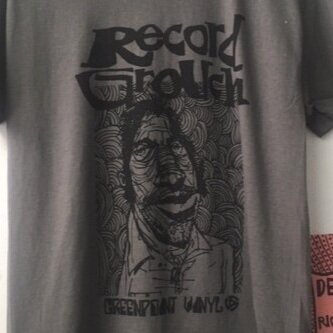
The art for this t-shirt was designed by our very own Rich Jacobs. Rich has a deep history in the subcultures of punk and hardcore. This is a one-time pressing of this shirt, so grab it while it’s available. If interested in seeing more of Rich’s work, take a look at his feed over on Instagram: https://www.instagram.com/movezine/?hl=en.